

Shrinking cities
Urban shrinkage is a complex process that affects many aspects of a city, from its physical structure to its social and demographic fabric. It is defined as a densely populated urban area that has on the one hand faced a population loss in large parts of it, and is on the other hand undergoing an economic transformation with some symptoms of a structural crisis. In addition, urban decline includes the natural decline stage in the urban development cycle, and the decline caused by the influence of external factors.

Concerning relevant studies (Graph1), economic restructuring and population decline are the main influencing factors for urban shrinkage. Changes in the economic environment are mainly reflected in deindustrialization and uneven economic development. At the same time, low fertility rates and the tendency for people to move to central cities have exacerbated the population loss of small and medium-sized cities. As a result of these factors, urban shrinkage is not only reflected in low urban populations and low employment rates, but also accompanied by a number of new strategies consisting in demolishing vacant buildings and “downsizing” the city.
The models used
In order to uncover the phenomenon of urban shrinkage of a city, the following three models will be combined in this paper.
The first one is the Central place model, which seeks to explain why cities are located where they are geographically and how they serve the surrounding smaller settlements with specialty goods and services. The second one is the Agent-based model, which can be applied to simulate the actions and interactions of agents so as to predict the outcome of urban development. What’s more, the third one is the Land-use-transport-interaction model (LUTI), which can be used to not only study how land-use policies affect the distribution of socio-economic activities and transport development in cities, but also explain how transport policies affect the spatial distribution of urban socioeconomic activities. As such, it has a major role to play in aiding decision-making.
The research flow
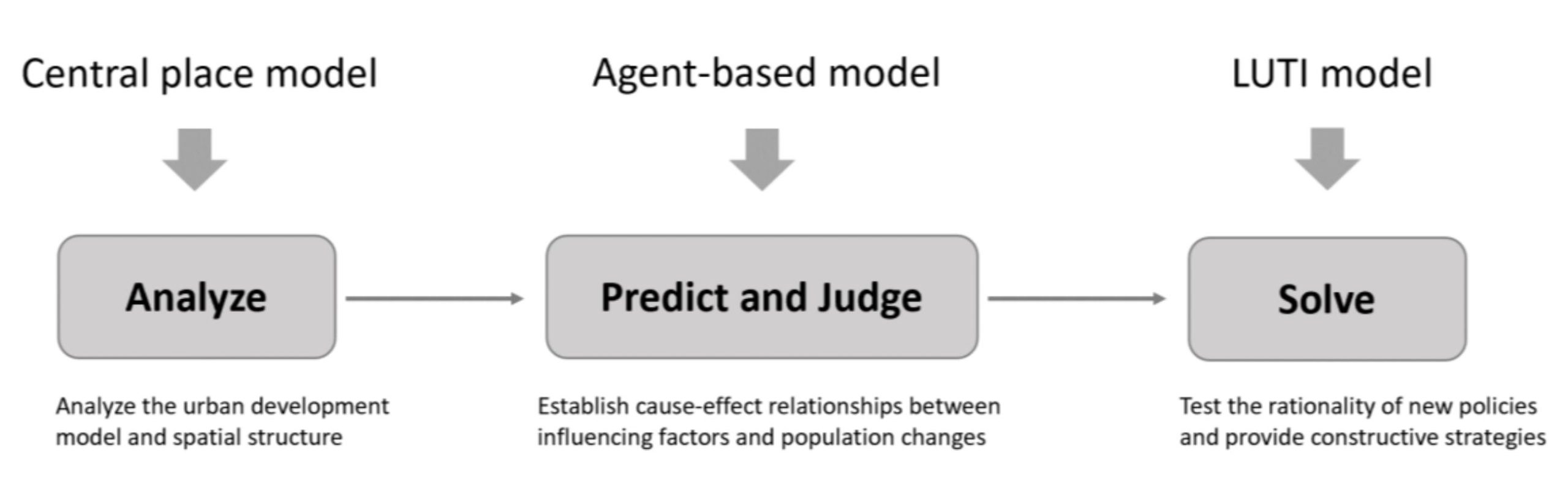
This study of urban shrinkage is divided into three main sections (Graph2). First of all, analyze urban development patterns and spatial structure, then predict and judge whether there is a phenomenon of urban shrinkage, and finally test the rationality of new policies and provide constructive strategies. In addition, the Central place model, the Agent-based model and the Landuse-transport-interaction model are applied in the three research steps respectively.
To begin with, in the first step, a certain city or region is chosen as the subject of study, and the central place model is applied to analyze the economic process among regions, so as to explain hierarchical patterns of urban size and location across space. As the population tends to move towards the central city, population loss tends to be more severe in small and medium-sized cities, exacerbating urban hollowing and urban shrinkage. According to the Central place model, central places become and stay large in population, area, and economic output, because they dominate a
region economically and thus limit the growth of nearby places, which in turn limits the growth of places encircling them. Therefore, the use of a central place model provides a good understanding of the economic structure of cities and correctly classifies areas, which is conducive to finding the key areas in research that are more likely to experience urban shrinkage.
Next, build an Agent-based model to simulate the movement and distribution of people when factors such as economic structure, labor market, and transportation convenience change. Because population change reflects the multidimensional phenomenon of shrinkage, population reduction is used as the dependent variable in the model to judge whether there is urban shrinkage. The agent-based model is used to establish cause-effect relationships between demographic or economic drivers and the local impact on population development. For example, as deindustrialization advances, core industries in some old industrial cities gradually lose competitiveness. These areas tend to become less economically strong and have a weaker labor market, thus resulting in a less favorable demographic situation.
Last but not least, to address and mitigate the phenomenon of urban shrinkage, the Land-usetransport-interaction model is used to test the rationality of new policies and to assist in making the right decisions. When the phenomenon of urban shrinkage occurs, the government often introduces relevant policies, but some policies are unreasonable and may even aggravate the shrinkage. However, the LUTI model can analyze the ongoing interaction between the land use system and the transport system to simulate the spatial evolution of the city (Graph3). In this way, policies can be optimized and simulations can be carried out to arrive at better decisions to deal with urban shrinkage.

Potential issues
Admittedly, there are some potential issues and limitations in the application of these models to the research process. First of all, the Central place model is based on ideal conditions, whose use to analyze the hierarchical patterns of urban size and location across space may deviate from reality to some extent. Besides, it is not easy to establish a clear causal relationship between demographic or economic drivers and influences on population development. Therefore, there may be some difficulties in building a suitable Agent-based model in the second step. In addition, LUTI models focus on intra-city spatial changes, making it difficult to evaluate the impact of spatial policies on urban macroeconomic systems. Because of its lack of linkage to macro issues, there are limitations in evaluating and optimizing policies. Furthermore, population change only reflects a certain extent the phenomenon of urban shrinkage, so it may be necessary to add secondary analysis to the study, such as the impacts of changing contexts on shrinking cities.
REFERENCE
Martinez-Fernandez C, Audirac I, Fol S, et al. Shrinking cities: Urban challenges of globalization[J]. International journal of urban and regional research, 2012, 36(2): 213-225.
Wolff M, Wiechmann T. Urban growth and decline: Europe’s shrinking cities in a comparative perspective 1990– 2010[J]. European Urban and Regional Studies, 2018, 25(2): 122-139.
Aurambout, J.P., Schiavina, M., Melchiori, M., Fioretti, C., Guzzo, F., Vandecasteele, I., Proietti, P., Kavalov, B., Panella, F. and Koukoufikis, G., Shrinking Cities, European Commission, 2021, JRC126011.
Pallagst K. The future of shrinking cities: problems, patterns and strategies of urban transformation in a global context[J]. 2009.
Niu Fangqu. Overview of Urban Land-use/Transport Interaction Model: Origin, Techniques and Future [J]. Geographical Science, 2017, 37(1): 46-54.